Showing posts with label Hispanic Market. Show all posts

Monday, March 31, 2014

Developments in the Hispanic Media Market


Media companies' interest in the booming Hispanic market increasing according to a recent timeline report released by the PewResearch Journalism Project. Providing a solid overview into the growth of media outlets geared towards the Hispanic market, the timeline highlights an important overview of the media landscape.
"What’s clear from the timeline is that general market companies, those that also own outlets geared to the overall U.S. population have jumped into the Hispanic news industry in recent years. Six of the seven national outlets listed were started by these general market companies, including a handful that are partnerships: Fusion is a partnership between ABC News and a company focused solely on Hispanic media (Univision) and MundoFox is a partnership between Fox International Channels (owned by 21st Century Fox) and RCN Televisión, a Colombian broadcast television company." 
The fact remains that solid material geared towards the Latino market has the potential to garner significant growth and relevance among an audience that is hungry for quality content. There are obvious pioneers in the business of Hispanic media. Today, the energy around entrepreneurship combined with rising technologies has presented individuals and organizations with a great opportunity to satisfy the market's desire for relevant content based on insights, cultural affinity, and good judgement.

It will be interesting to see the continued rise of winners and losers in this competitive landscape.


Wednesday, November 20, 2013

Latino Startups to Watch in 2014

In this third post in a series on Latino startups, Oxford SBS Seed Fund co-founder Mark Hand highlights the Latino market startups on the path to startup success. Check out the first and the second posts in the series, too.

When Peter Wilkins of New Futuro set out to raise a round of venture capital this year, he found very few investors that understood his target market: US Hispanics. In the VC community, he still says, "there is no one that I know of focused on Hispanic market companies."

That lack of understanding on the part of investors hasn’t slowed down New Futuro. Through its events, resources, and online community, New Futuro now provides educational advice and material it says reaches millions of Hispanics every year. In the footsteps of companies such as HolaDoctor, Xoom, Progreso Financiero, and Consorte Media, New Futuro is part of a new crop of Latino market startups that are raising cash, building teams, and charging into the Latino market.

The most active sector for Latino market startups is financial services. Regalii, led by Wharton MBA and Echoing Green Fellow Edrizio de la Cruz, follows in the footsteps of iSend in allowing families to have some a say in the spending of remittances. Currently in beta launch according to its website, Bucks Bill Pay allows customers to pay their bills in cash at local agents. And Juntos Finanzas, a product of Stanford d.school, empowers Latino customers to track their own expenditures by SMS, similar to India-based social enterprise InVenture.

Along with New Futuro, another crop of Latino market startups focuses on education: YogoMe is an educational app with plans to move into language learning. Backed by 500 Mexico City (which announced its new batch of startups just last week), YogoMe is one example of how companies are pulling in resources from both American and Mexican startup ecosystems. Sleek-geek has three educational tablet apps for teachers, and is one of seven companies in the first Manos Accelerator cohort that includes Antonio Altamirano's Interesante. Plaza Familia is another educational venture founded by Latino social media veteran Ana Roca Castro.

Beyond financial services and education, immigration services platform LexSpot has raised over half of its $750,000 convertible seed round. YaSabe, another 500 Startups portfolio company building a bilingual, local search engine, closed a $2.7M funding round in the first half of 2013. AssuredLabor, based in NYC and with operations in Brazil and Mexico, raised $5.5M earlier in 2013 to expand its job-seekers platform.

Keep an eye on these companies in 2014--no doubt at least one of them will soon stand with Xoom and others that have built successful businesses by serving a large and growing US Hispanic market.

Who did we miss? Let us know in the comments.

--

A couple of notes: iSend is a portfolio company of Gray Ghost Ventures, Mark's former employer. Also, thanks to Barney Santos from Gentefy Media for his help in pulling this list together.

Saturday, September 21, 2013

The State of Latino Startups: Exploring the Challenges

In this second post in a series on Latino startups, Oxford SBS Seed Fund co-founder Mark Hand explores some of the obstacles that Latino-run and Latino-focused startups face. Read the first post in the series here.


Startup struggles, generally speaking


If there is one topic that entrepreneurs love to talk about more than any other, it is be the trials and tribulations of being a founder. You work impossibly long hours; you wake up with cold sweats knowing that every moment you’re not working on your idea, your competitor is. You spend more time managing people than you do with the product that you wanted to build; you are constantly reminded by more ‘reasonable’ friends and family members that you are sacrificing prime earning years to chase a dream. Money is always in short supply, and no one--no one--can ever truly give you the peace of mind that you are doing it right.

In nearly one hundred conversations about Latino startups over the last eight months, I’ve also heard and identified a handful of other hurdles specific to Latino startups. Some of them are relevant to Latino founders; others are particular to startups whose primary customers are Latinos.


Latino founders' uphill fight for funding?

Latino founders, just like their non-Latino counterparts, point to the lack of high-risk capital as a significant barrier to the growth of Latino startups. Unlike in conversations with white founders, however, hints at racial bias among funders are pretty common in conversations with Latino founders. Few accuse venture capital investors of outright racism. Instead, they make two arguments. The first, voiced by at least one venture-funded entrepreneur, is that venture investors have the same subconscious racial bias that Chicago Booth researchers discovered among hiring managers in Boston and Chicago. Venture capital (VC) investors retort that if they see a strong team with a good idea in a growing market, they don’t care about someone’s race or country of origin. In fact, Silicon Valley is so dependent upon foreign talent that they now lobby ferociously for immigration reform.

The second, related argument is that the nature of many VC investors’ networks is such that black and Hispanic entrepreneurs are excluded not due to racial bias but because of the nature of social networks. In a recent conversation about the opportunity for a Latino-focused startup fund, one VC asked me if I was saying all VCs were racist. “No,” I said, “We’re lazy.” When some VCs proudly trumpet that a resourceful entrepreneur will find the right introduction to them, they are trusting their network to complete the first round of vetting of potential startups. In the aggregate, such a closed-network approach to deal-sourcing means out-of-network ideas are shut out until someone (a “broker” in network theory) connects them.

Before they approach VCs for scale-up funding, however, Latino founders point to another gap in funding. Unlike founders from well-connected, wealthy backgrounds, Latino founders have fewer wealthy friends and family members waiting in the wings to pump $20,000 into their startup. One Latina founder told me that, as the most educated and successful member of her extended family, asking her family for money would be laughable; instead, she is expected to be the one with a steady job providing cushion for everyone else. In this way, Latina founders, already carrying much of the weight of the growing Latino startup community, may be loaded down even more than their male counterparts by familial expectations. 


The Latino market: large, nuanced, tough

What of startups that are not run by Latinos but focus on the Latino market? They too, face special struggles both in financing and execution. In seeking financing from VCs, Latino market startups struggle to get attention from investors rightly inclined to fund what they already know--e.g. tech, life sciences, solar, mass market retail, defense. Why educate yourself on a new, unproven market, exposing yourself to even greater risk? The answer, of course, is that not only are Latinos a large and growing group of upwardly mobile young consumers, but they are early adopters of new technologies and bellwethers for shifts in consumer trends; but as Antonio Altamirano points out, this case has yet to be made in a clear and compelling way.

Even given funding, Latino-focused startups face a special challenge: the Latino market may be huge, but it is incredibly nuanced and diverse. Most obviously, Latino market startups have to balance the needs of English-dominant and Spanish-dominant customers; the fluently bilingual customer support and content creators required to do this are tough to find and harder to retain.

Yet both Latino founders and those interested in the Hispanic market are plowing ahead. One example of such forward momentum is Manos Accelerator, which has recently accepted their first cohort of Latino startups. In our next article, we’ll take a closer look at a few of the Latinos and Latino-focused entrepreneurs blazing the trail--if you know of a few, send them our way!

Mark Hand (@markchand) is the cofounder of the SBS Seed Fund, a student-run startup fund within Saïd Business School at the University of Oxford. He spent two years with Gray Ghost Ventures investing in early-stage companies in the US and India. Mark is currently researching startups in the US Hispanic market. Photo by Phil Roeder from Wikimedia Commons.

Friday, July 12, 2013

Verizon and J. Lo Team Up to Sell Smartphones to Latinos


Will it work?

Verizon and Jennifer Lopez team up to open 15 Viva Movil retail locations in Hispanic neighborhoods throughout the U.S. by the end of 2013. The mobile giant is placing a big bet on these niche shops by focusing on the elements of language, familiarity via crossover appeal, and custom shop design to market to Latinos.
"Targeting Hispanic-American consumers was the result of Verizon recognizing the importance of phones among Hispanic-Americans, according to Jeetendr Sehdev, the branding expert hired to spearhead the Viva Movil launch. Hispanic-Americans use their phones more than the general population and are more celebrity-focused, Mr. Sehdev said, thus making Ms. Lopez a natural fit."
Read more on How Verizon Is Using J.Lo, Kids' Playgounds to Sell Smartphones to Hispanics.

Tuesday, June 18, 2013

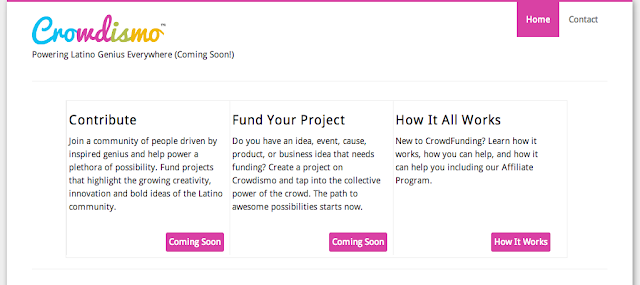
Crowdismo Unveils Pioneering Platform Aimed at Launching Innovative Ideas Throughout the Latino Community


Crowdismo Powering Latino Genius Everywhere via Crowdfunding 
Crowdismo Launches Pioneering Platform Aimed at Launching Innovative Ideas Throughout the Latino Community

The Heartful Giving Project, Crowdismo's first crowdfunding campaign. 

SANTA BARBARA, CA - June 18, 2013 - Crowdismo, an online crowdfunding platform, today announced the launch of a new online website aimed at helping the Latino community activate creative and innovative ideas.

Maintaining an overall positive outlook on the economy and future of America, Latinos are champions of possibility and agents of change placing a priority on collective impact. Crowdfunding is a mechanism of activation allowing today’s tinkerers and inspired inventors an opportunity to launch fresh ideas of global relevance.

Recent data outlines a Latino audience that starts businesses two to three times the rate of non- Latinos. However, access to capital and traditional barriers in the financing sector comprise a serious threat to creativity, invention, and entrepreneurship. Crowdismo hopes to change that by offering a unique bilingual and bicultural online destination.

“It’s imperative that we foster a community of synergy and build both intellectual and financial capital driven by access to powerful economic resources that will enable continued momentum throughout the Latinosphere in the U.S.,” said Jose Huitron, Co-Founder of Crowdismo. “Crowdfunding levels the playing field in an arena where only 1% of VC money goes to African Americans and Latinos.”

On the cusp of a unique opportunity to take idea investment and new venture priority to another level, Crowdismo is aimed at leading the charge in innovation funding, idea powering, and community impact. Crowdismo eliminates barriers to entry by providing a mechanism for collective financing via the collaborative web.

Crowdismo is founded by two individuals with similarly identifying characteristics but diverse and dynamic talents. Together, Jose Huitron and Jose Guevarra comprise a powerful duo combining a robust technology skill-base and integrated marketing communications prowess.

Crowdismo’s mission is to power bold ideas throughout the Latino community across the arenas of culture, education, social impact, entrepreneurship, music, design, technology, and creativity.

Leading the pack of unique purpose-driven Crowdismo campaigns, is the Heartful Giving Project, a crowdfunding project aimed at supporting international folk art by providing a community arts center where local artisans can practice and teach their skills in Sua, Ecuador.

“The Heartful Giving Project is an example of the type of creative and globally relevant projects that we hope to activate and serves as a landmark of hope and possibility.” said Jose Guevarra, Co-Founder of Crowdismo.

ABOUT CROWDISMO
Crowdismo is a disruptive online platform aimed at powering creativity and innovation within the Latino community via modern collective financing known as crowdfunding. As a fresh destination for launching bold ideas, Crowdismo allows individuals to join a groundswell of people driven by inspired genius and help power projects in the areas of education, entrepreneurship, social impact, music, film, technology, and more. For more information, visit http://www.crowdismo.com

Contact:
Jose Huitron 
info@crowdismo.com 805.214.8281

###

Wednesday, June 12, 2013

Upscale Hispanics Immune to Total Market Strategies - Reach Hispanic

Latino Purchasing Power
An article featured in the Wall Street Journal highlights findings from a recent AHAA report, which positions upscale Latinos as an economic force to be reckoned with. WSJ goes as far as calling upscale Hispanics the most “influential segment since the Baby Boomers.” While these findings come as no surprise to economists and ethnographers (and is still music to Hispanic marketers’ ears) upscale Hispanic media consumption could represent a challenge for marketers looking to target this group by way of a “total market approach”.

A total market approach to media buying means that by targeting the general population, there will be a certain amount of Hispanics targeted as a given. According to AHAA’s findings, upscale Hispanics’ cultural assimilation (as evidenced by their media consumption) isn’t a one way street, and thus could pose problems to marketers looking to reach this group as a side effect of reaching out to the general market.

In 2012, upscale Latinos (belonging to households that earn 50-100k annually) accounted for 29 percent (15 million) of the U.S. Hispanic population — a number that is expected to double by 2050. The WSJ states that “this viable and sophisticated market boasts 40 percent (or $4 out of every $10 Hispanic dollars spent) of Hispanic spending power, lives in a world of cultural duality, and provides lifetime value and upside opportunities for many high-end and luxury brands.”  According to the article, this “cultural duality” fuels media consumption and purchasing trends, stating that “deeper pockets do not translate to increased assimilation.”

“Upscale Hispanics live in two cultures, with three-quarters speaking both English and Spanish. While they are slightly more English-dominant, their strong cultural duality and bicultural behavior is reflected in their media consumption.” For marketers that are keen to target upscale Hispanics, this distinct cultural reality poses an interesting challenge. According to the AHAA study “over one third of upscale Hispanics watch content in both languages (with English-language comedies, documentary-style programming and children’s weekly programming as the most watched) but switch to Spanish-language television for cultural events, concerts and sports.”

While there is no cut and dry method to engage Hispanics, AHAA’s study does reiterate the value of courting upscale Hispanics and stresses the benefits of anthropological insights when attempting to do so. According to the study’s findings, the increasingly popular “total market approach” to target upscale Hispanics (which are defined by their cultural duality as expressed in their media consumption) is inadequate to say the least. As Hispanics continue their economic assimilation in the US, their cultural assimilation will be on their terms.

Article by Sergio Guarin of Reach Hispanic.


Friday, March 22, 2013

Latinos in Social Media to Partner with LEAD to Connect Summit Participants via Social Media


SAN BERNARDINO, Calif.-The Latino Education and Advocacy Days project has named Latinos in Social Media (LATISM) as its ambassador for this year's LEAD summit. The day-long summit will take place at Cal State San Bernardino, on Wednesday, March 27, 2013, from 8:00 a.m - 5:30 p.m. at the Santos Manuel Student Union. LATISM and LEAD's social media team will solicit and train interns from CSUSB, University of La Verne, and East Los Angeles College to assist with twitter, facebook, and instagram traffic the day of the summit. Participants are encouraged to use the hashtags #LEAD2013 and #LATISM_LA when participating via social media.


Jessica Valle, the director for LATISM Los Angeles will collaborate with Jose Rivera, adjunct faculty at CSUSB's Communication Studies department, in the selecting and training of interns. Student participants will learn the principles of social media engagement and put said principles to use during the summit.

"LATISM Los Angeles is very happy to partner with LEAD in helping develop young professionals and help educate in the realm of technology and social media," said Ms. Valle.

Interns serve on the Social Media Team as "Ambassadors" to enhance, brand, and expand external online communications, and build an engaged and vibrant member community around Latino Education.  The interns actively represent the team on social networking sites such twitter, facebook, and instagram...

Latinos in Social Media (LATISM) is a 501(c) 4 nonprofit, nonpartisan organization dedicated to advancing the social, civic and economic status of the Latino community. LATISM has been hailed as the most influential online movement in the new multicultural Web. For more information about LATISM Los Angeles contact Jessica Valle at valle.jessica@gmail.com

The LEAD Summit's purpose is to promote awareness of the crisis in Latino Education and to enhance the intellectual, cultural and personal development of our community's educators, administrators, leaders, parents and students. Online registration for the free Summit is now open at the LEAD website at http://leadsummit.csusb.edu/

Wednesday, March 6, 2013

40 Hispanic Digital and Marketing Resources You Need to Know

Everywhere you look there's probably a very talented individual or organization providing insights and quality perspective into the arena of engaging today's $1.3 trillion Latino market. A recent post on the term "post-cultural" by Giovanni Rodriguez is just one good example of how the discussions around Hispanic marketing have evolved into a collection of very dynamic perspective that transcend the boundaries of language, culture, digital ethnography, communication, social engagement, and public influence.


The following is a list of some of the leading resources and providers of insights, tips, and strategies in the field of Hispanic Marketing: 
  1. AdAge Hispanic Insights into the Hispanic marketing arena as provided by AdvertisingAge.
  2. AHAA The voice of Hispanic marketing.
  3. BodenPR Blog Insights and information on developing and rolling out U.S Hispanic strategies from the team at BodenPR.
  4. Center for Hispanic Marketing Communication at FSU authoritative source of knowledge, production, education, and professional training in Hispanic Marketing Communication in the United States.
  5. CEO Blog Perspective and insight provided by Geoscape CEO Cesar Melgoza.
  6. Circulo Creativo Promoting creative excellence and communication among professionals focused on the U.S. Latino market.
  7. Engage:Hispanics Perspectives provided by MediaPost.
  8. Hispanic Business Top news resource for Hispanic entrepreneurs, professionals and small business owners.
  9. HispanicAd The tool for the Hispanic advertising and media professional.
  10. Hispanicize Leading social media resource for Hispanic marketers and influencers.
  11. Hispanic Digital Consumers Report  A IAB and BIGinsight report covering Hispanic Consumers’ purchase intent, media influence, consumer confidence, language preference, top online and mobile activities, video usage and a look at device ownership and usage.
  12. Hispanic Digital Media News and insights from LatinVision.
  13. Hispanic Market Advisors Information on tapping into Hispanic internet users.
  14. Hispanic Marketing Blog by Claudia "Havi" Goffan of Target Latino.
  15. Hispanic Marketing and Online Media Facebook Group 
  16. Hispanic Marketing and Public Relations News and information by Elena del Valle.
  17. Hispanic Market Info A blog for Hispanic marketers.
  18. Hispanic Market Weekly Authority on news and events moving the Hispanic market.
  19. Hispanic Online Marketing Captura Group's blog featuring best practices, case studies, and research for Hispanic online marketers. Contributions by Lee Vann.
  20. Hispanic PR Blog Your guide to Hispanic Public Relations and Social Media News & Views.
  21. Hispanic Trending The original Hispanic marketing blog by Juan Tornoe. Documenting Latinos' imprint in America.
  22. JoeKutchera.com Official website of Joe Kutchera, a leading social marketing advisor and speaker and the author of Latino Link: Building brands online with Hispanic communities and content.
  23. LATISM Blog Latinos in Tech Innovation and Social Media.
  24. Más Wired  For, by, and about Latinos in Tech focused on showing the incredible contributions Latinos are making in the digital space.
  25. Media Rumba Online Hispanic marketing and media ecology blog by Frankie De Soto.
  26. Marketing to Latinos (ClickZ) Provides trends, insights, and practical tips on how to reach, engage, and profit by marketing to Latinos.
  27. Marketing Trends in a New Multicultural Society Cultural understanding in marketing is a growing branch in the study of consumer behavior. Perspective by Dr. Felipe Korzenny.
  28. Mercury Mambo Hispanic Marketing Blog Information on Hispanic Shopper Marketing, Event and Experiential Marketing, Sales Promotions, and Branding.
  29. Multicultural Marketing News Information on how to market to multicultural (ethnic and niche) consumer markets.
  30. PewResearch Hispanic Center Founded in 2001, the Pew Hispanic Center is a nonpartisan research organization that seeks to improve understanding of the U.S. Hispanic population and to chronicle Latinos’ growing impact on the nation.
  31. Pinterest Pins related to the Hispanic market.
  32. Portada Leading source of news and analysis on the Latin Marketing and Media space.
  33. Reach Hispanic U.S. Hispanic and Latin American resource.
  34. ReachHispanics.co Hispanic online marketing blog by Martin Ramirez.
  35. Think Multicultural Covers the multicultural marketing and advertising world through the transformative lenses of the digital media. Co-contributors Jose Villa and Danny Allen.
  36. Think with Google Consumer trends, marketing insights and industry research provided by Google.
  37. The New American Consumer: Trends in Hispanic Consumer Demographics Report Experian offers this informative report, which identifies key trends among Hispanic-American consumers. 
  38. Twitter Search An active stream of conversation around the #HispanicMarket hashtag.
  39. Univision Insights Research and perspective from Univision delivered to your inbox.
  40. Zubi Nation Erasing stereotypes.
Who did we miss? Suggestions are definitely welcome!


About Vista Hispano
Vista Hispano is the official Hispanic marketing blog of Hub 81 providing insights into the trends and changing demographics of the U.S. Hispanic market.

About Hub 81
An integrated marketing communications agency based in Santa Maria on the beautiful Central Coast of California. Forward-thinking strategic partner helping clients navigate today's multicultural digital engagement and Hispanic marketing landscape.


Saturday, February 23, 2013

Crowdismo: Fueling Innovation and Creativity in the Latino Community through Crowdfunding

If the U.S. Hispanic market were a nation, it would boast one of the largest economies in the world with spending power of $1.2 trillion. The realities of today's Hispanic market are that of opportunity, motivation, aspiration, altruism, and hustle. The power and influence of the U.S. Latino collective is undeniable. Many awesome individuals and organizations from the West Coast to the East Coast are launching new ideas, connecting communities, and genuinely shaking the status quo. How can we build upon this momentum and continue to fuel innovative ideas and new opportunities throughout the U.S. Latino market? Enter Crowdismo. (Disclaimer: I'm a co-founder of Crowdismo and believer in bold possibility.)

Crowdismo: The U.S. Latino Crowdfunding Website

Crowdismo is a disruptive platform aimed at powering creativity and innovation within the Latino community through crowdfunding. A digital destination and site for individuals to join a groundswell of people driven by inspired genius and help power the prolific. Our goal is to eliminate barriers to entry for gente with bold ideas. By tapping into the power of the crowd, Crowdismo connects you to awesome possibilities in the form of funding.

How it works:
  1. Pitch your project to an online community of early adopters and believers.
  2. Incentivize backers to pledge to your project with unique rewards.
  3. Hit project’s funding goal and get one step closer to activating the incredible.


The Hispanic crowdfunding platform.

Age Factor
Overall, those between the ages of 25 and 34 are most likely to make investment decisions via crowdfunding platforms. The median age of Latinos is 27.6 making them the youngest demographic in the U.S. and perfectly aligned to adopt crowdfunding as a means of powering projects across a wide array of arenas including: Education, Technology, Social Impact, and Entrepreneurship to name a few.

Explosive Growth
"...the unassailable fact is that Latino-owned businesses in the United States are growing at a blistering pace." Latinos are three-times more likely to start businesses than the general population. Nielsen's State of the Hispanic Consumer report offers additional insights into the reach and growth of Latinos in America.

Philanthropic
Looking at Experian Simmons data, we know 47% of U.S. Hispanics donated to a charity or philanthropic organization in the last 12 months (Experian Simmons, Fall 2011 NHCS Adult Survey).

According to a recent post in Forbes online, "Sixty-nine percent of Hispanic respondents ranked “help people who are in need” as No. 5 on their list of aspirations compared to only 27% of non-Hispanics, who ranked this at No. 14. They want to make a difference, and if you can facilitate that, you can endear your brand to these consumers."

It's imperative that we foster a community of synergy and build both intellectual and financial capital driven by access to powerful economic resources that will enable continued momentum throughout the Latinosphere in the U.S. Crowdfunding levels the playing field in an arena where only 1% of VC money goes to African Americans and Latinos.

We're on the cusp of a unique opportunity to take investment and new venture priority to another level and Crowdismo is targeted at leading the charge in innovation funding, idea powering, and community impact.


Crowdismo coming soon 2013! Sign up for early access. Or join Crowdismo on Facebook.


Wednesday, August 29, 2012

Mobile and Latino Empowerment

Mobile broadband is connecting America's Hispanic community in empowering new ways, resulting in greater economic, educational, health, and civic opportunities for Latinos.

In fact, a recent report by the Hispanic Institute and Mobile Future reveals that the 50.5 million Hispanics living in the U.S. today are increasingly turning primarily to mobile broadband rather than wired connections as their main on-ramp to the Internet.

The report, "Hispanic Broadband Access: Making the Most of the Mobile, Connected Future," shows Hispanics are among the most active users of mobile broadband among all demographic groups in the U.S. They also tend to be more geographically mobile than the overall U.S. population and rely more heavily on wireless services generally. Today, 90 percent of Hispanics ages 18-29 own cell phones; 70 percent have laptops, more than 51 percent have smartphones, and almost 20 percent have tablets.

These astonishing technology adoption rates by Hispanics are driving equally rapid uptake in the use of mobile broadband for promoting education, health care, access to financial service and civic engagement. And during this presidential election year, mobile technologies are offering the Hispanic community a bullhorn for civic engagement. (Source: Hispanic Trending)


Thursday, June 14, 2012

Latin America Leads as the Most Socially-Engaged Global Region

A recent comScore report on social networking in Latin America shows that more than 127 million Latin Americans ages 15 and older visited a social networking destination from a home or work computer in April 2012, with the average visitor spending 7.5 hours social networking during the month. The report also provided analysis on emerging social network Pinterest.com, which saw its audience increase eightfold in the first four months of the year to reach 1.3 million Latin Americans in April.

“Not does nearly 100 percent of the Latin American Internet population visit social networking destinations each month, but they also spend a lot of time on the sites,” said Alejandro Fosk, comScore senior vice president of Latin America. “While social networking isn’t a new phenomenon, we are still seeing strong market growth, changing dynamics among the leading players, and the emergence of new social sites that make it an especially interesting market to watch right now.”


Latin America is an ideal and burgeoning market for technology, social media, and startups. 

For the full article, visit comScore.

Thursday, May 31, 2012

For Hispanic Americans, a Mega-Boom in Homeownership is Revving Up

"Hispanics are enthusiastically angling for the American dream of a home to call their own. Predictions indicated that between now and 2020, Hispanics  – the second largest ethnic group in America — will account for  50 percent of new buyers . Currently, 75  percent of first time buyers are white while Hispanic home buyers constitute 11 percent, a 38 percent increase over 2010 figures.  And as their purchasing power increases, a “mega rise” may be on the way."
We are currently at a crossroads where Latinos are impacting almost every industry in some form or another and recent data regarding homeownership speaks to the growth and influence of Latinos in America. The collective whole of the Latino population segment has presented both marketers and curious onlookers with a prime window of opportunity to create synergies that foster positive growth for America across virtually all forms of industry.
"In general,  Hispanics hold fast to the American dream. According to national housing surveys, despite worries over jobs and the economy, they  are more eager to become homeowners for both emotional and financial reasons.Though only 32 percent of all Americans consider owning a home a symbol of success, 56 percent of Hispanics believe that it is. Additionally, 68 percent of Hispanics versus 57 percent of all Americans are more likely to think purchasing a home is a sound economic decision. And 73 percent of Hispanics compared to 57 percent of all Americans feel that home ownership is a good path to building family wealth for future generations."
For the full article, visit Hispanic Americans Holding Fast to the American Dream

Monday, March 12, 2012

Bringing Hispanic to The Mainstream

What we need to focus on is how social media and the communication tools before us can open up a gateway of commonality and erase barriers of misunderstanding. Latinos are active, social, empowered, and genuinely interested.

It doesn't take a genius to recognize the growing influence of Latinos both online and offline. With over 50 million Hispanics living in the U.S. and over 32 million online, you'd think marketers nationwide would clamor to connect with this growing population. Latinos aren't just present but instead command a sphere of influence that exudes with accomplishment, impact, celebration, and cultura.

The proof is in the pudding and apparently marketers are still reluctant to request their piece of the pie. Mobile and digital spend overall is only a small portion of total ad spend.
Even when brands recognize the importance of reaching Hispanics with social media and mobile technology, some say, efforts are misguided.
To many, this news comes as no surprise. An approach to capture the attention of the Hispanic market is oftentimes based on assumptions rather than insights and tends to be built on the status quo. Perhaps the biggest challenge facing marketers isn't justification of an immense opportunity for impact and engagement but instead consists of moving decision makers towards a recognition of the immense responsibility, rather, opportunity for retro-marketing.

Instead of marketing to Latinos, why don't brands and influencers seek out ways to bring Latino to the mainstream? The likes of Q'Viva! serves as a perfect example of what it means to answer the challenge of building bridges instead of silos.

We are challenged to be the ambassadors of all that is good, beautiful, and empowering about the Hispanic culture. To shift the attitudes of the mainstream, one must focus on commonalities, synergy, and the windows of opportunity for cultural fusion.

The possibilities are numerous.

Those who answer the challenge are sure to find a wealth of benefits and reap significant rewards.

There's no denying it. The time for individuals, organizations, and brands to think beyond the bottom line is now!


Thursday, January 19, 2012

Saying "Sí" to Business Opportunities

Found this interesting post over at Hispanic Trending which paints a nice picture into the growing influence of Latinos in Minnesota.

Manny and Vicky Gonzalez are reminded each day that it isn’t only Spanish speaking people who stop to purchase Mexican (“tortas”) sandwiches at their two restaurants in Minneapolis.

“A lot of Minnesotans have learned that there is more to Mexican food than tacos,” said Manny, who with his wife started Manny’s Tortas along Lake Street in 1999.

In the past century, long-time Minnesota families learned there was more to Italian cuisine than pizza, and that Chinese food is regional and far more complex than chow mein. Now, Minnesotans with newly acquired tastes for the Gonzalez’s Mexican sandwiches drive from throughout the Twin Cities metro area to their two shops in Minneapolis’ Mercado Central and Midtown Global Market.

U.S. Census data from 2010, anecdotal evidence about immigrant entrepreneurship, and a recently released study from the Immigration Policy Center show Minnesota is rapidly changing. Days of sputtering along and resisting change should be behind us. New Minnesotans are changing the demographic portrait of the state and communities. New ethnic entrepreneurs are changing the mix of businesses and the products and services being offered in commerce.

Hector Garcia, executive director of the Chicano Latino Affairs Council (CLAC), refers to the benefits of this commerce as “cultural complementarities.” The long established Minnesota society learns from immigrants and refugees entering the state in search of opportunities, he said, and new arrivals learn from established businesses, groups and people.

What’s more, new Census data show that immigrants now comprise 8.3 percent of the Minnesota workforce. From them, Garcia said, existing Minnesota businesses and its large corporations gain knowledge for opening even more trade and business relationships with countries and businesses abroad, paving the way for even more economic activity.

The never-ending task for CLAC and other government agencies, nonprofit organizations and community leaders is to educate people to see new arrivals to the state and to business activity as “assets,” and not “liabilities” that need services, he said.

This year, 2012, is the next scheduled survey of business owners in America by the U.S. Census Bureau. Its findings should reveal explosive growth by ethnic entrepreneurs since the last survey in 2007.

Data on this growth is mostly anecdotal but was examined in a Minnesota 2020 November report. It showed the Hispanic/Latino community is reviving business activity in Willmar, Worthington and various other rural Minnesota communities, as are ethnic entrepreneurs throughout neighborhoods in the Twin Cities metro area.

Tom Webb, writing in Sunday's Pioneer Press, observed that the combined Hmong Village and Hmongtown Markeplace in St. Paul have more merchants and service providers on site than the Mall of America, for instance. Garcia said the 2012 survey of business owners should provide similar information for Hispanic/Latino owners. The 2007 survey showed Latino-owned businesses had $1.6 billion in revenue and employed 5,970 people. Both figures are expected to swell in the coming study.

From anecdotal evidence, business startups from the ethnic communities are believed to be young and within the five-year range from the last business owner survey. That makes Manny’s Tortas, now entering its 13th year, a long established enterprise both by restaurant standards and by ethnic ownership experience.

That baker’s dozen of years experience in Minneapolis gives Manny Gonzalez a perspective on how economic activity builds and how markets change. When the Gonzalez family first opened shop in Mercado Central (1515 East Lake Street), most of the customers were fellow Hispanics, he said. Now, the customer base is “a good mix of everyone who wants a good, different sandwich.”

This mix of customers spills over on Minnesota and Minneapolis economies. Manny and Vicky Gonzalez now employ 12 people.

Sunday, January 8, 2012

When it Comes to Reaching Latinos Online, Marketers Have Room for Improvement


Creative that appeals to race, background is key to engagement


Brands that want to reach ethnic minorities online are not doing a very good job, according to some research. An April 2011 survey by Yahoo!, Mindshare and Added Value found that according to Hispanics, blacks and Asian-Americans, digital advertising does not engage them. When asked for three brands doing a good job reaching them, most said they couldn’t name even one.

One big reason was that respondents felt their ethnic groups were poorly represented in messaging. Some 78% of blacks, 74% of Hispanics and 72% of Asians surveyed agreed that diversity in ads is the best reflection of the real world. And nearly as many in each group said ads should show more of that diversity.

Reaching these groups and building resonance is about understanding the unique interests of today's multicultural audience and the important element of authenticity.

One way to be authentic is to reflect consumers’ core values and interests. The study found particular cultural “drivers” important to ethnic groups. For about half of blacks surveyed, music and beauty were significant. For Hispanics, a big driver was food and recipes, and for Asian-Americans, restaurants that reflect their tastes were key.

Source: eMarketer

Thursday, November 17, 2011

New Lingo for Marketers Targeting Hispanics


Today's U.S. Hispanic millennials are more bilingual and bicultural than ever. They make up 21% of America's millennial generation of 18-34 year-olds and are 14 million strong. These individuals see themselves as 100% Latino and 100% American often moving between several cultural experiences with ease.

Today's Hispanic millennials are the ultimate multi-tasker or as some put it 'fusionistas'.

They watch football and futbol and live in a world where options for cultural expression are numerous. Think of it as the ultimate experience in customization. It's a lot like creating your own class in Call of Duty where individuals have numerous options to create the perfect offensive package and compete in a battlefield for the ages or perhaps more closely resembling an open canvas where individuals are armed with the creative potential for unique cultural expression.

No matter how we describe this cultural fusion the truth of the matter is that individuals, organizations, and brands must pay attention to the changing dynamics of today's audiences and the terms that attempt to define them. Of course, we all know that no single population can be locked in a categorical box but it's the important elements of recognizing unique characteristics that help drive effective communication.


Tuesday, September 20, 2011

Reading Material for Today's Hispanic Market Insider

Hispanic Market Articles
Image Credit

Staying on top of today's growing Latino market is a must for individuals and organizations focused on reaching new heights in audience engagement, market savvy and brand affinity. We are in the midst of a directional shift where astute brand managers and market researchers alike move full speed ahead on the path towards fully grasping the growing influence and dynamic activity of what is termed the Hispanic market. Following are a few articles that are sure to serve as relevant reading material on this continual journey towards audience understanding...

Hispanics’ Digital Dexterity Defies Stereotypes
Hispanics in this country have a duality. They’re trying to meld their American life with traditions and culture from their country of origin. It makes for an interesting dynamic of someone living in and balancing two worlds. Within that, we really wanted to uncover how Hispanic consumers think about themselves.

Get Ready for the Battle of the Latino Basket
How one company wanted to go to market with "an open mind" and, through innovation, bring Latino flavors to mainstream products.

Multicultural Marketing Is Very Much Alive
As the voice of the Hispanic-specialized marketing industry, we know that cultural relevance remains the trump card in marketing, regardless of the population segment you are trying to reach. Therefore, it is vital to have marketing practitioners who not only reflect the target market but also understand these cultural nuances.

Multicultural Is the Wave of the Future
Changes in demographics, marketing tools and corporate expertise have made multicultural marketing more relevant than ever. In fact, multicultural marketing, particularly targeting Hispanics, has grown at a faster rate than overall marketing in the past 10 years .


Wednesday, September 14, 2011

7 Hyper Relevant Facts on the Hispanic Market

Back in May 2011, comScore reported that 787,000 Hispanics visited Tumblr, making up 9% of total U.S. traffic. (Tweet)

In the past 12 months, Tumblr's total U.S. traffic grew 218% while Tumblr's U.S. Hispanic traffic grew 312%. (Tweet)

Latino digital getting lots of alone time these days because of its surprising status in the digital marketing food chain. (Tweet)

Early experiments in the most promising sector of the Latino marketing world - digital - will pay off big. (Tweet)

Latinos, in the aggregate, out-index all other ethnic groups on public social networks. (Tweet)

12% of US Hispanic mobile users use social networks on their mobile vs. 10% of the general market. (Tweet)

87% of Hispanic households have multiple mobile phones... Tweet)

Thursday, September 8, 2011

Quick Facts About Latinos in the Tri-Counties

Image credit

The following are a collection of quick facts helping to paint a better picture of the Hispanic population in Santa Barbara, San Luis Obispo, and Ventura counties. Insights that matter...


San Luis Obispo County

Persons of Hispanic or Latino origin - 55,973

21% Share of the population.

Within the county, 7.9% businesses are Hispanic-owned firms.

Santa Barbara County
Persons of Hispanic or Latino origin - 181,687

43% Share of the population.

Within the county, 13.9% businesses are Hispanic-owned firms.

Ventura County

Persons of Hispanic or Latino origin - 331,567

40% Share of the population

Within the county, 15% businesses are Hispanic-owned firms.


More facts about Latinos in California:

Between 2006 and 2008, the number of Latinos who earned undergraduate degrees in California grew by 13 percent, while other groups increased by just eight percent.

Among the top 10 states enrolling Latinos, California had the largest increase in degrees conferred to Latinos over three years.


However, college completion among Latino students in California still lags behind their Non-Hispanic White counterparts.


Sources

David, E. (2011). Despite progress, California Latinos lag behind others in college completion. Retrieved from http://www.edexcelencia.org/newsroom/pressreleases/2011/08/despite-progress-california-latinos-lag-behind-others-college-complet

Pew Hispanic Center. (2011) Retrieved from http://pewhispanic.org/data/census2010/ 

Friday, August 19, 2011

The End of the PC Era

For nearly 30 years, personal computers as we have known them have been the drivers of the technology engine. From Intel to Microsoft to Dell to HP to Micron Technology — many fortunes were made on the back of the PC. But the rise of mobile computing is upending the technology business and is simultaneously redefining what is a personal computer and how we use it.

On Thursday Hewlett-Packard, one of the oldest companies in Silicon Valley with deep connections to the PC ecosystem (they paid $25 billion for Compaq in 2002) and the world’s largest seller of PCs, confirmed it is looking to sell off its personal computing business. It’s also getting out of the hardware game altogether, ditching its tablet and smartphone operations too. But if HP does eventually find a buyer for its PC division, it will only be catching up with IBM, which in 2004 decided that the low-margin PC business wasn’t worth pursuing.

HP is not the only company that is finding itself on the wrong side of PC history. Earlier this week Dell reported its earnings and acknowledged that its bread-and-butter PC business isn’t what it used to be.

Read the full article or learn more about how Hispanics are a key driver of this trend through the increased adoption of tablets.